
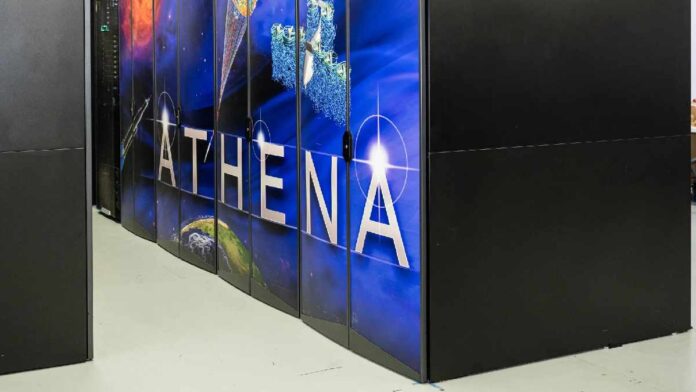
In January 2026, NASA officially brought its most powerful supercomputer to date online. Named Athena, this petascale system represents a massive leap in the agency’s computational infrastructure, specifically designed to be the “digital brain” behind the upcoming Artemis II mission and beyond.
Housed at the Modular Supercomputing Facility (MSF) at NASA’s Ames Research Center in Silicon Valley, Athena isn’t just a hardware upgrade—it is a critical asset for the next era of human deep-space exploration.
The Specs: A Petascale Powerhouse
Athena was built by Hewlett Packard Enterprise (HPE) using the HPE Cray EX4000 platform. It utilizes a high-density, liquid-cooled architecture that allows it to operate with significantly higher energy efficiency than its predecessors, Aitken and Pleiades.
| Feature | Specification |
| Peak Performance | 20.123 Petaflops (20+ quadrillion calculations/sec) |
| Processor | AMD EPYC “Turin” (128-core processors) |
| Total Cores | 264,144 physical cores |
| Total Memory | 786 TB of system memory |
| Interconnect | Cray Slingshot-11 (high-speed networking) |
| Operating System | Tri-Lab Operating System Stack (TOSS) |
Why “Athena” Matters
The name was chosen via an internal NASA contest in 2025. In Greek mythology, Athena is the goddess of wisdom and warfare—and importantly, she is the half-sister of Artemis. This connection highlights the supercomputer’s primary mission: supporting the Artemis lunar program.
Key Use Cases
- Artemis II Mission Planning: Engineers use Athena to run complex simulations of the Orion spacecraft’s trajectory and the Space Launch System (SLS) rocket’s performance.
- Safety & Risk Analysis: It models radiation exposure for astronauts and simulates re-entry conditions to ensure crew safety during the first crewed lunar flight in over 50 years.
- AI & Machine Learning: Athena is designed to train large-scale AI foundation models that can sift through massive datasets from Earth-observing satellites and deep-space telescopes.
- Aeronautics: Designing the next generation of ultra-efficient, “green” aircraft by simulating airflow and structural integrity in high-fidelity digital wind tunnels.
Efficiency and Sustainability
One of Athena’s most impressive feats is its modular design. Unlike traditional supercomputers that require massive, energy-hungry buildings, Athena sits in the MSF—a flexible, warehouse-like environment that uses outdoor air and specialized cooling technology. This reduces utility costs and the overall carbon footprint of NASA’s high-end computing.
“Exploration has always driven NASA to the edge of what’s computationally possible. With Athena, we provide tailored resources that meet the evolving needs of our missions.” — Kevin Murphy, NASA Chief Science Data Officer.

